


Exclusive Interview with Global Views Monthly: MICROIP Solves AI Implementation Gaps, Deploying a "Software-Defined Hardware" Strategy Across Global Industries
🎉 Heartfelt thanks to Global Views Monthly for the in-depth feature! 🎉
MICROIP's "Software-Defined Hardware" strategy successfully connects global industrial chains, delivering real-world AI value in defense and security sectors. As Chairman James Yang stated: "The future of AI lies in the depth of its deployment." Our proprietary AIVO (AI Vision Operation) platform transforms AI from lab data into a powerful tool for industrial pain points.
💡 Three Key Operational Scenarios
🔹 Smart Transit Security: Beyond recognition to "Reading Intent." Accurately analyzes behaviors to distinguish crowd pushing from conflict, enabling active pre-warning for public safety.
🔹 Drone Tracking: Eliminates target loss in battlefields. AIVO predicts paths and motion vectors to maintain a precise lock even when targets are obscured.
🔹 Precision Maintenance: The "1-centimeter" guardian for Wafer Fabs. 24/7 monitoring of minute equipment shifts prevents massive production losses in semiconductor lines.
🌍 Taiwan-Based, Global Impact From defense to precision manufacturing, MICROIP empowers legacy hardware with "AI souls" through software-hardware integration. We continue to lead the global market in AI vision operations!
🔗Read the full report on Global Views Monthly:
English Translation of the Original Feature in Global Views Monthly:
From Metro Safety to Battlefields: MICROIP Cuts into AI Innovation with "Software-Defined Hardware" Strategy
January 14, 2026 | 盧佳柔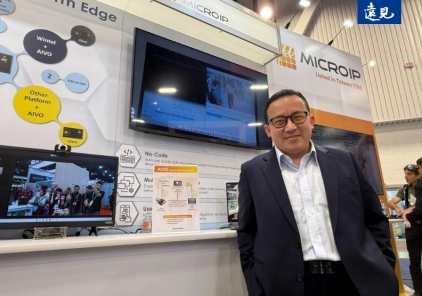
(James Yang, Chairman of MICROIP, leads his team to bring AI from battlefields into cities and industrial sites through a "Software-Defined Hardware" strategy.)
While most Taiwanese tech firms are still competing in chip fabrication, packaging, and hardware specifications, MICROIP has chosen a "path less traveled." Instead of rushing to sell faster chips, the company focuses on a more fundamental challenge: "How to make AI truly operational." Through its Software-Defined Hardware strategy, MICROIP is penetrating diverse sectors, including battlefields, law enforcement, public transit, and even semiconductor automated production lines.
Solving the "Lost Target" Crisis in Battlefields
High above the front lines in eastern Ukraine, drones fly low, hugging the treeline. On the screen, a Russian tank accelerates into a sharp turn, disappearing into a dense forest before emerging from the other side seconds later. For most conventional drone systems, once a target is obscured by the canopy, it is often flagged as "lost," and its tracking data is immediately purged. When it reappears, the system identifies it merely as a new, unrelated object.
"In warfare, this essentially means failure," said James Yang, Chairman of MICROIP, quoting the field experience of drone operators. "If you lose track once, there is no second chance."
This battlefield necessity has unexpectedly opened a new commercial frontier for MICROIP. Originally founded as an IP and ASIC (Application-Specific Integrated Circuit) design house, the company has pivoted its focus toward its proprietary AI vision platform—AIVO (AI Vision Operation)—attempting to unify various hardware devices through software.
James Yang explained that AIVO was first tested in combat environments. Unlike traditional models that rely on single-frame object detection, AIVO simultaneously analyzes motion vectors, velocity changes, path prediction, and environmental relationships. Even if a tank briefly disappears behind trees or buildings, the system can recognize it as the same entity upon its return.
This capability has brought inquiries from European drone manufacturers, including those collaborating with the U.S. and Ukraine. For these companies, while image clarity is important, the ability to maintain a "continuous lock" is the true metric of battlefield value.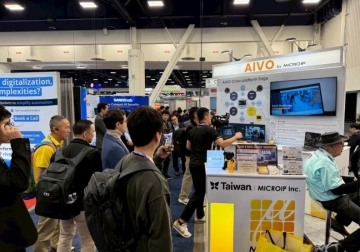
(Caption: MICROIP develops AIVO technology.)
Securing AI Software Upgrade Orders for U.S. Law Enforcement
The demand for AIVO transcends the battlefield. During the recently concluded CES 2026, MICROIP successfully collaborated with U.S. system service providers to integrate its AI platform as a foundational AI Engine into existing law enforcement equipment.
James Yang noted that U.S. police departments have begun adopting real-time video analytics to transform cameras from mere recording tools into intelligent systems. These systems help determine the presence of weapons or high-risk individuals and relay data to command centers instantly to decide on reinforcements.
"Law enforcement agencies cannot afford to replace all their equipment for the sake of AI—it's too costly and slow to implement," Yang said. "MICROIP's role is to upgrade existing cameras and servers into 'risk-assessing systems' via software."
He emphasized: "We provide platform capabilities, not a full set of hardware. The focus is on upgrading original hardware rather than starting from scratch." For highly decentralized police systems with complex generations of equipment, this hardware-agnostic, cross-platform software architecture has become a pragmatic solution for AI adoption.
Beyond Action: Reading "Intent" in Public Transit
Moving beyond combat and policing, MICROIP is bringing AI into subway cars to solve the most common yet difficult-to-judge urban safety scenarios.
A random attack near the Zhongshan Metro Station in Taipei late last year left the public on edge, prompting transit operators to evaluate technology that could mitigate the risk of sudden violence. The key technology lies in upgrading imaging systems.
MICROIP's team discovered that many existing systems trigger a "violence alert" simply by detecting a punching motion. However, in urban settings, aerobic exercise, street dancing, or even peak-hour crowding can produce similar physical movements, leading to frequent false alarms.
Environmental factors further complicate metro cars as a testing ground for AI. James Yang pointed out that cars are filled with poles, straps, and dense crowds, often obscuring faces. In such environments, judging the "intent" behind a movement is extremely difficult.
The AIVO (AI Vision Operation) platform deconstructs movements into vector directions, acceleration patterns, and rhythmic regularity, combined with human poses and group interactions. This allows the model to differentiate between aggressive behavior and non-violent actions like dancing or accidental pushing. This model is currently being tested and deployed on multiple metro lines in Taiwan, with ongoing negotiations for applications in major European and U.S. subway systems.
"The battlefield is an extreme environment, but the metro is harder. Millions of people move through it daily with unpredictable actions. To succeed in a city, you must be stable enough to run in a subway car."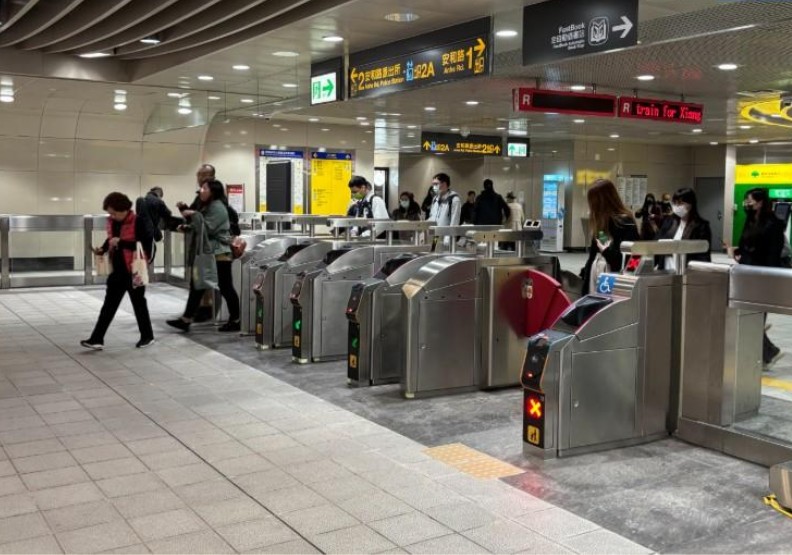
(Mass transit operators are accelerating evaluations of technology to reduce the risk of sudden violent incidents.)
The "One-Centimeter" Opportunity in Wafer Fabs
MICROIP's AI platform has found another stage in a place with almost no people: the wafer fab.
James Yang mentioned that in semiconductor production lines, automated wafer storage equipment can reach heights of six meters. A mere one-centimeter displacement—often caused by Taiwan’s frequent earthquakes—can cause robotic arms to fail, leading to wafer breakage and losses totaling millions of dollars.
By deploying AIVO in "lights-out" factory environments, MICROIP provides continuous monitoring. If displacement exceeds a set threshold, the system triggers an immediate alert to the central control room. The model’s parameters are also adjusted based on the seismic frequency of different factory zones.
Previously, this work relied on engineers performing manual patrols. Now, AI performs the initial diagnosis, allowing human experts to focus on high-value repairs and calibration. James Yang describes this as a "one-centimeter business" that potentially saves wafer fabs hundreds of millions in potential losses.
Software as Taiwan's Next-Generation Competitiveness
From drones and police cameras to subways and wafer fabs, MICROIP uses a single software platform to bridge vastly different industries.
This path is not easy. James Yang admitted that while Taiwan has long excelled in hardware manufacturing, its software platforms and system integration capabilities have remained relatively weak. "The past 20 years were the golden age of hardware, but also the era where software capability accumulated the slowest."
However, as AI computing power becomes commoditized, the real gap will no longer be chip specs, but who can deploy AI faster, more stably, and at a lower cost. From the battlefields of Ukraine to urban safety and autonomous production lines, MICROIP is proving that Taiwanese companies can do more than just build AI hardware—they can be leading providers of AI software exports.